
A spine diagnosis can bring more than just a treatment plan. It often introduces a range of options, each with different implications for recovery, function and long-term outcomes. For many patients, it can make decision-making feel less straightforward, especially when recommendations involve ongoing care or the possibility of surgery. Dr. Larry Davidson, a board-certified neurosurgeon with fellowship training in complex spinal surgery, recognizes that patients often benefit from taking time to better understand their diagnosis before moving forward with a specific treatment path.
Seeking a second opinion is one way to approach that process. It is not about questioning a physician’s expertise, but about gaining a clearer understanding of the condition and the range of reasonable options available. In spine care, where multiple treatment approaches can often be appropriate, this added perspective can help patients move forward with greater confidence.
Why Spine Conditions Often Have More Than One Approach
Spinal conditions rarely have a single, fixed solution. Issues such as disc herniation, spinal stenosis or degenerative changes can often be managed in different ways depending on how symptoms present and how they progress over time.
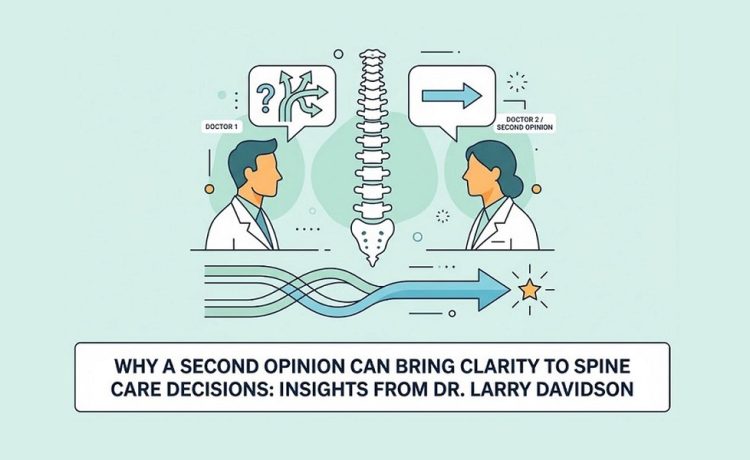
Two physicians may review the same imaging and arrive at different recommendations, not because one is right and the other is wrong, but because each is weighing factors such as symptom severity, functional impact and patient goals in slightly different ways. One may emphasize continued conservative care, while another may consider whether earlier intervention could be appropriate.
This variability reflects the complexity of spine care. A second opinion allows patients to see how different clinical perspectives interpret the same information, helping them better understand the reasoning behind each approach.
Confirming the Diagnosis
One of the most important roles of a second opinion is to confirm that the diagnosis accurately reflects the patient’s symptoms. Spine conditions can present in overlapping ways, and imaging findings alone do not always provide a complete answer.
A second specialist may review MRI or CT scans alongside a detailed discussion of symptoms, looking for alignment between what is visible on imaging and what the patient is experiencing. In some cases, this review reinforces the original diagnosis. In others, it may lead to a more refined understanding of the condition.
This step is important because treatment decisions are only as effective as the diagnosis on which they are based. Confirming that the foundation helps reduce the likelihood of pursuing care that does not address the primary source of symptoms.
Understanding Different Clinical Perspectives
Every spine specialist brings a slightly different perspective shaped by training, experience and clinical focus. Some may prioritize conservative management for as long as possible, while others may consider earlier intervention in certain scenarios.
These differences are not necessarily conflicting. Instead, they reflect how complex spine conditions can be interpreted through multiple valid approaches. A second opinion provides an opportunity to compare these perspectives and understand the reasoning behind them. This comparison can be especially helpful when recommendations differ. It allows patients to ask more informed questions and better evaluate which approach aligns with their expectations and comfort level.
Identifying Additional Treatment Options
A second opinion may also introduce treatment options that were not initially discussed. These could include different physical therapy strategies, alternative pain management techniques or newer surgical approaches that may be appropriate for certain conditions.
Even when the overall recommendation remains the same, learning about these options can provide reassurance that all reasonable paths have been considered. It also allows patients to feel more engaged in their care, rather than simply following a single prescribed plan. This broader view can be particularly valuable in cases where symptoms have persisted or where previous treatments have not produced the expected results.
Reducing Uncertainty in Decision-Making
Uncertainty is a common part of dealing with spine-related conditions. Symptoms may change over time, and treatment decisions often involve weighing potential benefits against possible risks. A second opinion can help reduce that uncertainty by providing additional context.
When two independent evaluations lead to similar conclusions, it reinforces confidence in the diagnosis and treatment plan. When they differ, it offers an opportunity to better understand the range of possible approaches and what factors may influence each one. In both cases, the goal is not to create confusion, but to provide clarity. Patients are better equipped to make decisions when they understand not just what is recommended, but why.
When a Second Opinion Is Most Useful
There are certain situations where seeking a second opinion can be particularly helpful. These include cases where surgery has been recommended, when symptoms are not improving as expected, or when the diagnosis itself is unclear.
It can also be valuable when patients want to feel more confident about their decision. Taking the time to gather additional input does not delay care unnecessarily. In many clinical scenarios, this step becomes part of a thoughtful approach to care rather than an exception.
A More Informed Approach to Spine Care
Decisions related to spine care often benefit from careful consideration and a clear understanding of available options. A second opinion can support that process by confirming the diagnosis, exploring different approaches, and helping patients feel more confident in their choices.
Dr. Larry Davidson emphasizes the importance of aligning treatment decisions with a clearly identified source of symptoms, particularly when considering more advanced interventions. This perspective reinforces that informed decision-making is not about choosing quickly, but about choosing carefully based on a complete understanding of the condition.
What Patients Can Expect from the Process
A second opinion typically involves a comprehensive review of medical history, symptoms and prior treatments. The specialist may also examine existing imaging or recommend additional studies if needed to clarify certain findings.
The goal is to provide an independent evaluation, not to repeat care unnecessarily. Patients are often encouraged to bring all relevant records so that the assessment is as complete as possible. This process allows the second physician to offer insight based on the same information, while also applying their own clinical perspective to the case.